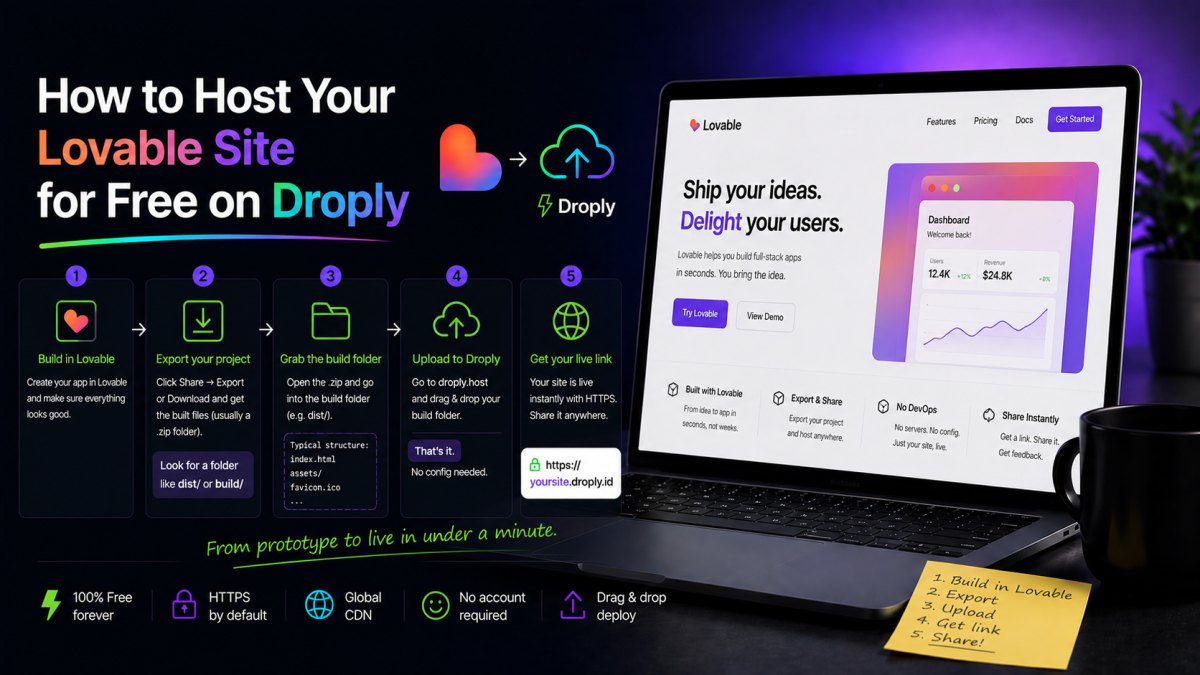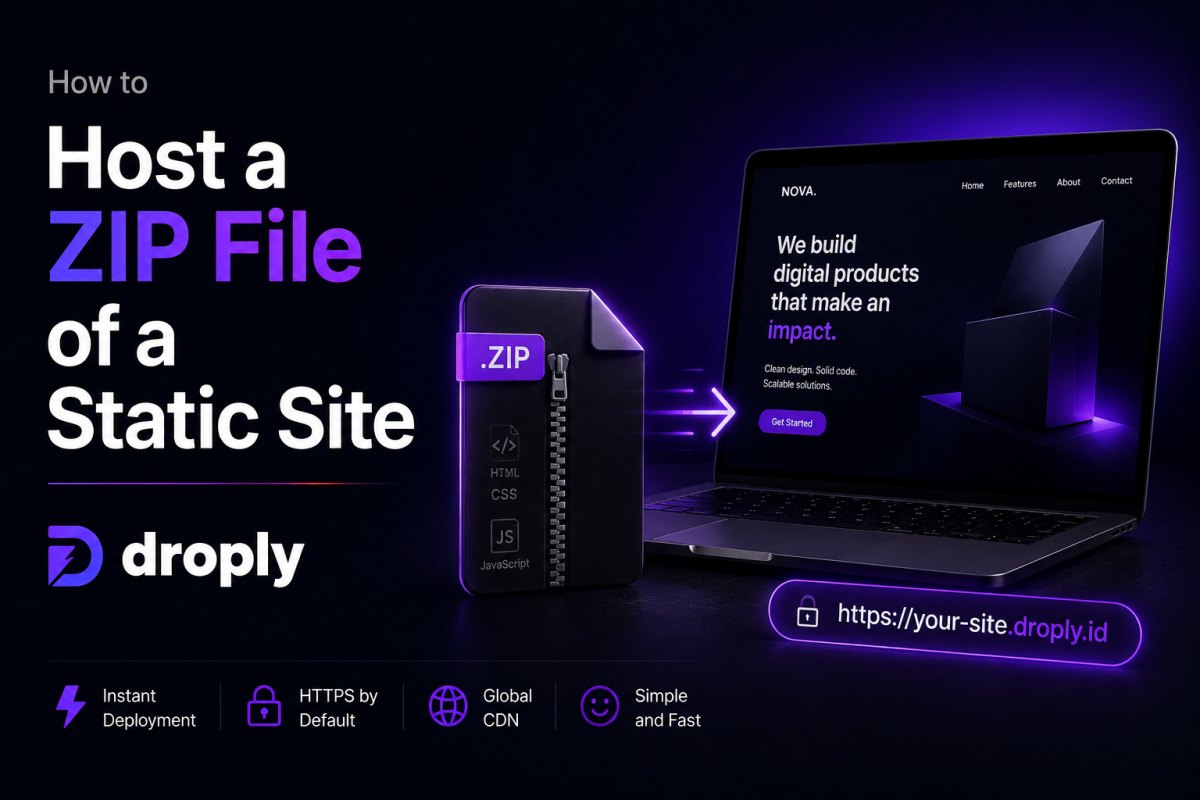
The fastest way to host a zip file of a static site is to drag it onto Droply, name it, and get a live HTTPS link immediately. No server setup, no command line, no build step: Droply unpacks the zip and serves it at <name>.droply.id in seconds.
That's the short answer. But there are real questions worth answering before you upload, especially if this is your first time shipping a static site (a site made of plain HTML, CSS, and images with no server-side code running behind it).
What counts as a "static site" I can zip and host?
A static site is just a folder of pre-built files: an index.html, maybe a style.css, an images folder, perhaps a bit of JavaScript for animations or a contact form that posts to a third-party service. If your site was made with a static site generator (a tool like Hugo or Eleventy that turns templates into plain HTML files), an export from a design tool, or hand-written HTML, it qualifies.
What doesn't qualify: anything that needs a server to run code while someone visits it, like a PHP site, a Node.js app with an API, or a WordPress install with a database. Those need actual server hosting, not static file hosting. Droply, and static hosts generally, only serve files exactly as they are; nothing runs on the server side.
How do I zip a static site correctly?
Zip the contents of your site folder, not the folder itself, so that index.html sits at the top level of the archive. This is the single most common mistake people make, and it's an easy one to check before you upload.
Here's the difference:
- Wrong:
mysite.zipcontains a folder calledmysite, and inside that folder isindex.html. - Right:
mysite.zipopens straight intoindex.html,style.css,images/, and so on.
If the host looks for index.html at the root of the zip and instead finds a subfolder, it won't know where your homepage is, and visitors will see an error or a blank page instead of your site.
Pro tip: before you upload anywhere, double-click your zip file and confirm
index.htmlis the first thing you see, not a folder. Ten seconds of checking saves a confused support ticket later.
How do I actually host the zip file with Droply?
Go to Droply, drag your zip file onto the upload area, and type in the name you want for your site. Droply extracts the archive automatically and publishes it at https://<name>.droply.id, live and reachable over HTTPS immediately, with no separate "deploy" or "build" button to click.
Concretely, the flow looks like this:
- Zip your static site folder (contents at the root, as above).
- Drag that zip file onto Droply's upload area, or click to browse and select it.
- Type a name, like
client-proposalorlaunch-page. - Wait a few seconds while Droply extracts the files.
- Get your live link:
client-proposal.droply.id.
If you need to fix a typo or swap in a new version later, re-upload the zip under the same name. The content updates in place and the URL stays exactly the same, so any link you've already shared (in an email, a Slack message, a client proposal) keeps working.
What if I only have a single HTML file, not a whole site?
You don't need to zip anything for a single file. Droply also accepts a lone HTML file or a PDF directly, no compression required, so if your "site" is really just one page or one document, skip the zip step entirely and drag the file straight in.
This is common for freelancers sharing a one-page pitch, a design mockup exported as HTML, or a signed contract as a PDF. The same naming and live-link process applies either way.
Can I use a custom domain instead of the droply.id subdomain?
Yes, but it requires a paid plan. The free flow gives you a working <name>.droply.id link right away; if you want your own domain, like sitename.com, pointing at the same hosted files, that's a feature on Droply's paid plans, which also remove the "powered by Droply" banner shown on free sites.
For a quick client preview or an internal draft, the free subdomain is usually enough. For a real client-facing launch, a custom domain looks more professional and is worth the upgrade.
When should I use something other than Droply?
Droply is built for exactly one job: taking pre-built static files (HTML, a zipped site, or a PDF) and making them live instantly, and it does that job with almost no setup. If your project needs a database, user logins, server-side code, or a build pipeline that runs every time you push a change, you need a different kind of host, such as a platform that runs your build process for you.
Be honest with yourself about which category your project falls into. If you already have an index.html sitting in a folder, or your generator already produced one, you're in static-site territory, and that's where Droply is the fastest path from files to a working link.
Quick checklist before you call it done
Run through this once your site is live:
- Your zip file's contents sit at the root level, with
index.htmlvisible immediately when opened, not buried in a subfolder. - You uploaded to Droply and got back a working
https://<name>.droply.idlink. - You opened that link in a browser and clicked through the main pages to confirm images, styles, and links all load correctly.
- If you'll be updating the site later, you know to re-upload under the same name rather than creating a new one.
- If this is for a client or public launch, you've decided whether you need a custom domain from the pricing page.
Hosting a zipped static site shouldn't take longer than building it did. Drag your zip onto Droply and it's live in seconds.